
ROME, Italy – 26 January 2026 – On Wednesday 28 January, at the National Gallery of Modern and Contemporary Art (Viale delle Belle Arti 131, Rome), the winner of the Connessioni Urbane competition will be announced. The cultural initiative—born from the collaboration between GNAMC and Techbau S.p.A.—is dedicated to promoting contemporary art as a tool for urban regeneration and dialogue with the city.
Cristina Mazzantini – Director of GNAMC: “Encouraging and rewarding contemporary creativity through open competitions dedicated to young people is part of GNAMC’s history and mission. We received as many as 41 submissions, many of which were highly interesting. I would like to thank the Academies and Universities that engaged professors and students, encouraging them to tackle a theme of great importance for the Capital. This success is the result of a virtuous inter-institutional collaboration and a fruitful public–private partnership.”
The competition is set within an urban context of major significance for the city of Rome, in a strategic area just a few steps from Vatican City. The site is marked by the presence of Roma San Pietro railway station—the Capital’s first railway station, inaugurated in 1894—and today used by millions of passengers every year. For local residents and those who experience the area on a daily basis, this space has long represented an unresolved state of limbo. Today, after a prolonged period of inactivity, the area is finally making way for an urban regeneration project designed to restore continuity, services, and renewed centrality to a neighbourhood that has remained in a state of suspension for years.
Andrea Marchiori – CEO, Techbau S.p.A.: “Campus San Pietro is a tangible expression of our approach to urban regeneration, understood as the integration of architecture, public space and sustainability. Within this framework sits the Connessioni Urbane competition, developed in collaboration with the National Gallery of Modern and Contemporary Art, which introduces contemporary art as a structural part of the project. An initiative developed in line with ESG principles and aimed at achieving BREEAM Excellent certification.”
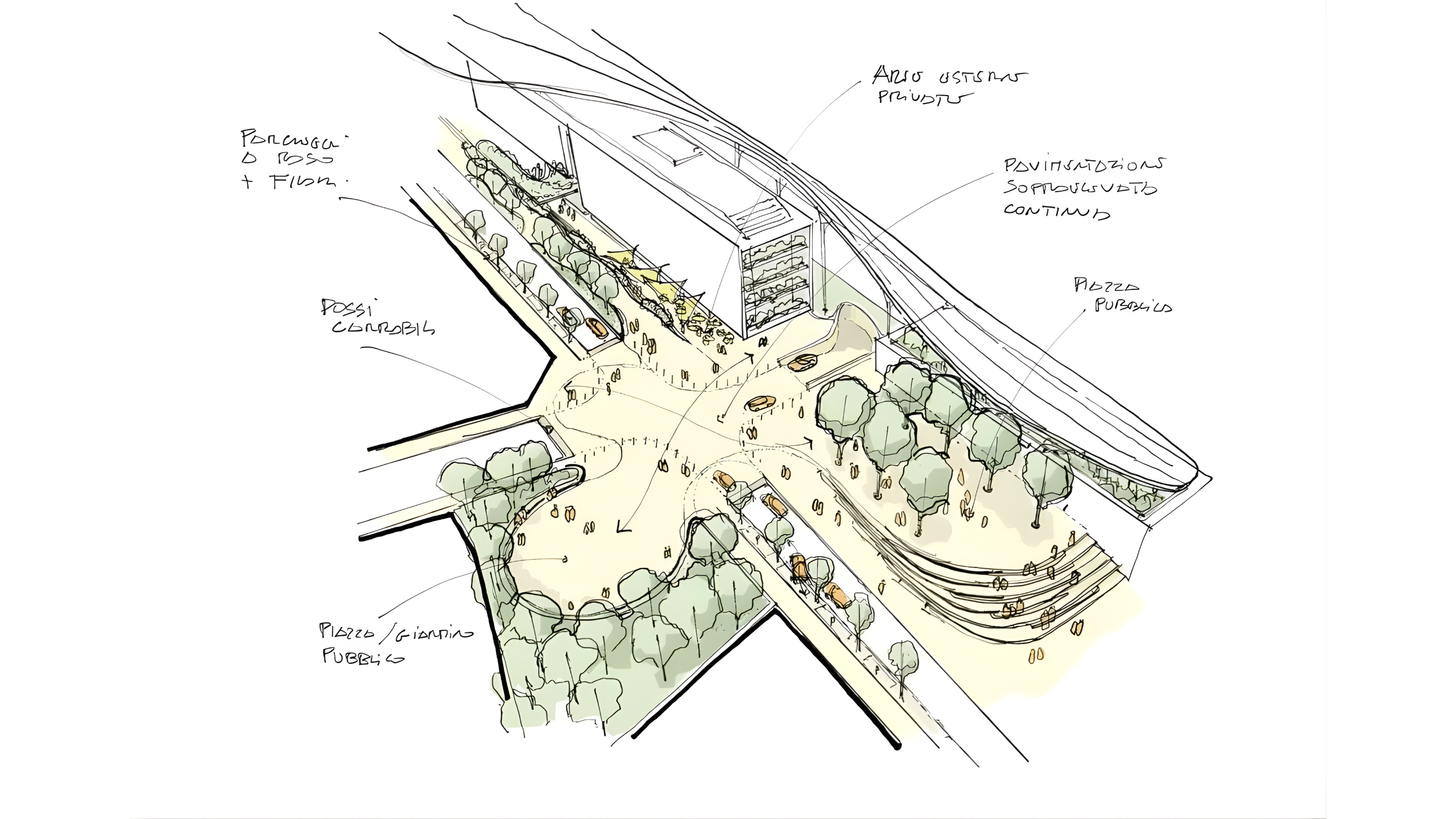
As part of this transformation process, the new multifunctional building on Via del Crocifisso is taking shape. Designed by MCA – Mario Cucinella Architects and built by Techbau S.p.A., it will include student housing, retail spaces, green areas and venues dedicated to public events. An integrated urban ecosystem, conceived to restore quality, services and new connections to a strategic area of the Capital—perfectly connected in terms of mobility and characterised by a strong cultural, academic and international presence. The project has also been made possible thanks to the collaboration with the Municipality of Rome, which has shared from the very beginning a vision focused on urban quality and the city’s future.
Maurizio Veloccia – Councillor for Urban Planning, Rome Capital: “Together with the winners of this competition, today we demonstrate how the public and private sectors can work side by side towards shared and collective regeneration. We also celebrate the talent and creativity placed at the service of a site that is being reborn and brought back to life: this, too, is urban regeneration. The new multifunctional building on Via del Crocifisso—after twenty years—will recover and revive an unfinished structure and a longstanding urban ‘wound’ in the heart of our city, and is set to become a new landmark for the neighbourhood. This is an initiative in which the Administration and the property owner have worked together to improve the original project and make public spaces more accessible and shared, also thanks to the contribution of the National Gallery of Modern and Contemporary Art which, through the installation of artworks, will further enrich the prestigious urban context in which the development is set.”
It is within this context that the Connessioni Urbane competition was born, engaging young artists who were invited to confront a symbolic site of Rome’s urban transformation: a wall 145 metres long and 10 metres high, located between the new “Crocifisso” multifunctional building and Roma San Pietro railway station. From a separating element, the wall will be reinterpreted as a narrative surface, designed to host a permanent and accessible artwork—an integral part of the urban landscape and of the neighbourhood’s everyday life. During the event, the ten finalist projects selected by the jury will be presented and the winner will be announced. The winning intervention will be realised within the multifunctional building, becoming a permanent part of the area’s renewed urban landscape. The finalist projects will also be exhibited in a public exhibition, open to visitors until 8 February.
Mario Cucinella, Architetto, Founder & Creative Director di MCA – Mario Cucinella Architects «L’intervento sull’edificio che ospiterà lo studentato e i servizi a livello strada è un’opera di rigenerazione che si propone di colmare un grande vuoto urbano, nel cuore della Città di Roma. Il progetto, per come è stato concepito, si pone l’obiettivo di abilitare nuove relazioni urbane, fino a questo momento negate, attraverso la riattivazione della strada grazie a iniziative di prossimità e al recupero della piazza e del piccolo parco. In questo scenario Connessioni Urbane ha il merito di aver innescato la riflessione sul rapporto con l’elemento del grande muro di contenimento della ferrovia. La sfida è stata quindi trovare un linguaggio che, a fronte di un edificio razionale simbolo di uno specifico metodo costruttivo, liberasse un codice espressivo in grado di dialogare sul contrasto: l’opera d’arte, con la sua matrice organica, gioca con la razionalità del contesto per una forma creativa libera e pittorica che rilancia il processo di rigenerazione urbana. Non a caso l’Architettura, l’Arte e lo Spazio Pubblico con le sue funzioni sono gli ingredienti di cui è fatta la Città.»
The Via del Crocifisso project therefore stands as a virtuous model of urban transformation, in which architecture, art and public space converge to shape a more inclusive and liveable city—creating urban, social and cultural value and contributing to a shared vision of high-quality public spaces.


